


菜单



立即预约

英 / 中


远程问诊

立即咨询



A note on terminology
This page uses tirzepatide and semaglutide, the generic names, rather than brand names, in line with Singapore's medical advertising guidelines, which restrict reference to registered trade names.
Before thinking about a switch, it helps to know what each weekly injection is registered for here.
✓ Semaglutide — Registered for weight management. The 2.4 mg weekly injection is registered for chronic weight management in adults with obesity, or overweight with at least one weight-related condition. (5)
✓ Tirzepatide — Registered for type 2 diabetes. Tirzepatide was first registered to improve blood sugar control in adults with type 2 diabetes. (5)
✓ Tirzepatide — Registered for weight management. It has since been registered for chronic weight management in adults, under similar criteria to semaglutide. (5)
▸ Switching — No official conversion. Neither manufacturer publishes a dose conversion chart between the two, so any switch should be planned by a doctor. (6)
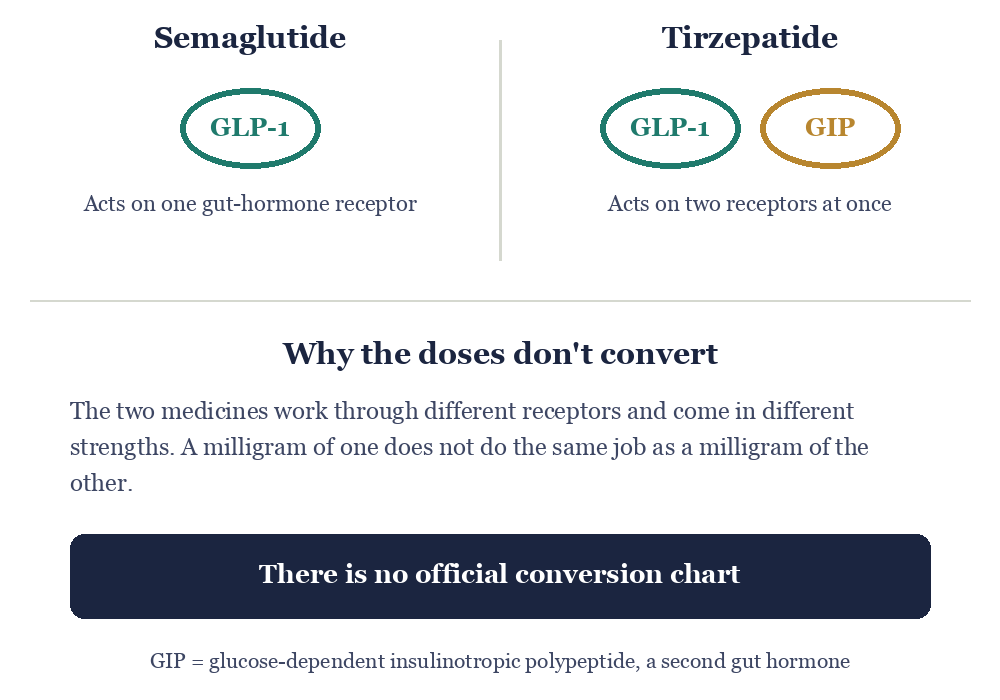
Semaglutide copies one gut hormone, GLP-1. Tirzepatide acts on two: GLP-1 and GIP, a second hormone that also affects appetite and how the body handles sugar and fat. (1) (2)
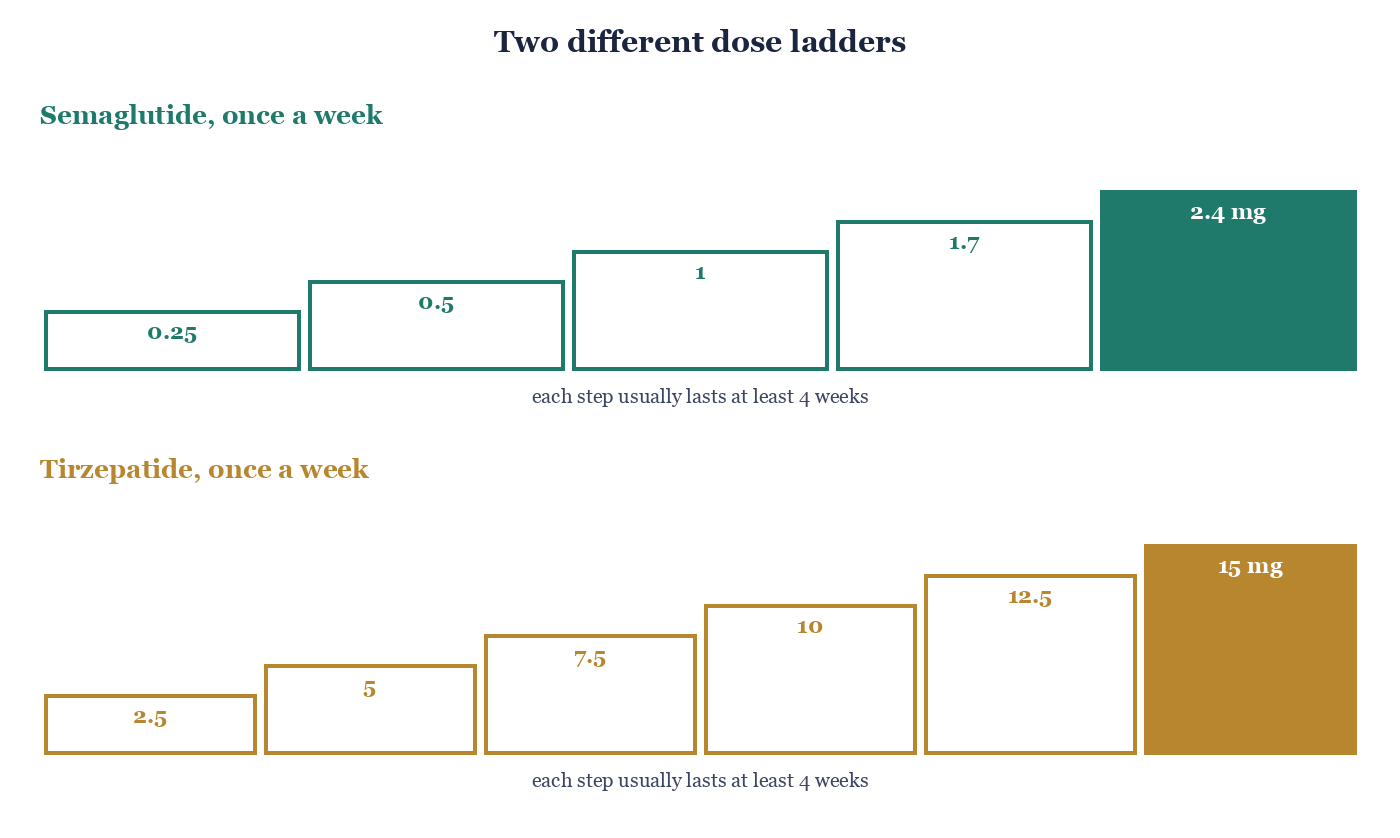
The two also come in very different strengths. Semaglutide steps up from 0.25 mg to 2.4 mg a week, while tirzepatide steps up from 2.5 mg to as much as 15 mg a week. (6)
So a milligram of one does not do the same job as a milligram of the other. Conversion tables found online are estimates. A starting dose should be set by a doctor who knows your history.
Each medicine has its own large weight-management trial, shown below. A newer trial, SURMOUNT-5, then compared the two directly. (1) (2) (3)
Trial
Population (n)
Medicine, top dose
Weight change vs placebo
Duration
STEP 1
1,961 · obesity or overweight
Semaglutide 2.4 mg
-14.9% vs -2.4%
68 weeks
SURMOUNT-1
2,539 · obesity or overweight
Tirzepatide 15 mg
-20.9% vs -3.1%
72 weeks
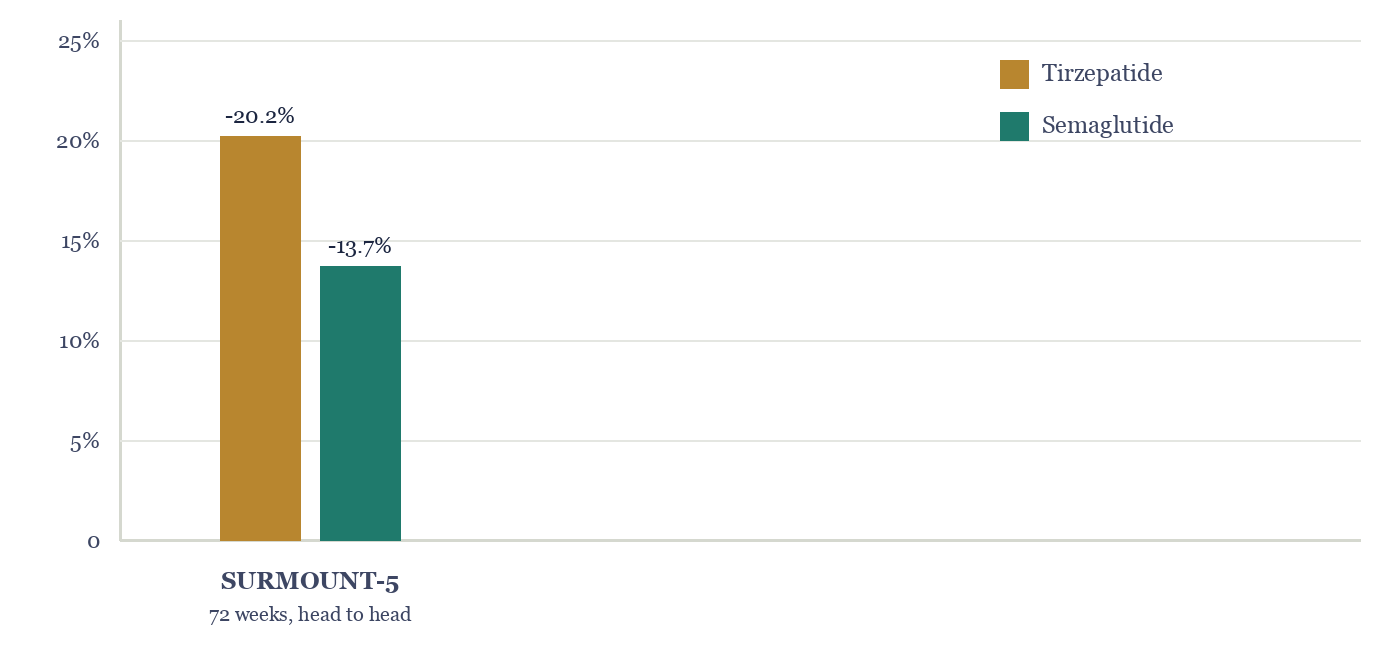
In adults with obesity and no diabetes, people on tirzepatide lost an average of 20.2% of their body weight over 72 weeks, compared with 13.7% on semaglutide. Each person took the highest dose they could tolerate. (3)
A head-to-head trial in people with type 2 diabetes (SURPASS-2) showed a similar pattern. Even so, some people do very well on semaglutide, and some find tirzepatide harder to tolerate. The right medicine is the one that works for you and suits your other health conditions. (4)
People move between the two medicines for many reasons, including:
A switch is not a failure. Responses to GLP-1 medicines vary from person to person, and changing treatment is a normal part of finding what works.
Whatever the reason, plan the switch with your doctor. Don't switch on your own with leftover pens or medicine from friends, family or online sellers.
Nausea or reflux can return briefly at the start and after each dose increase. Appetite may feel different for a few weeks, and weight loss may pause before settling again. Stopping treatment altogether, rather than switching, usually leads to weight regain. (7) (8) (9)
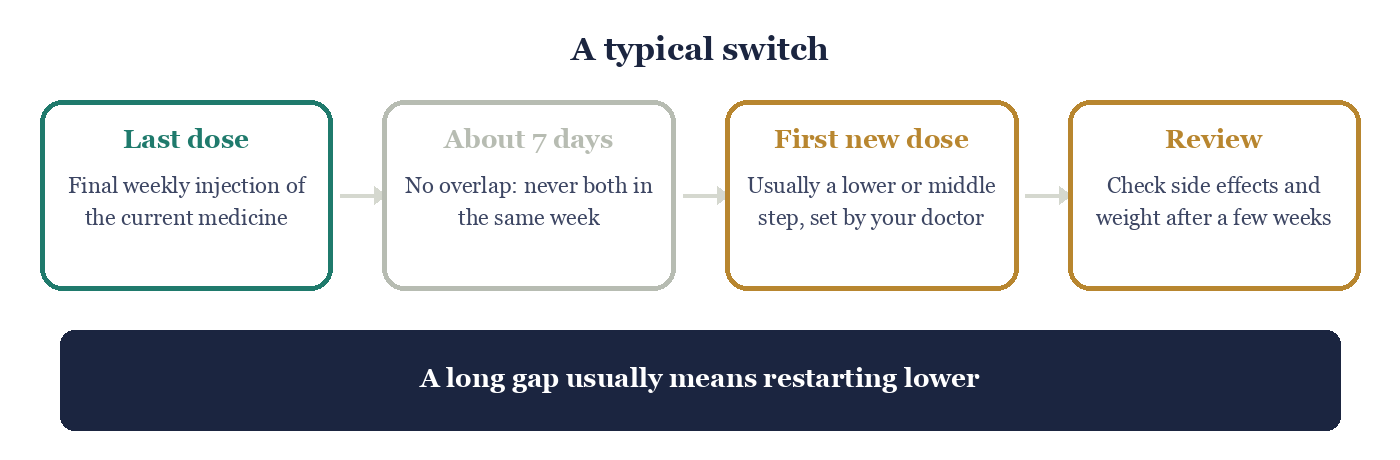
Both medicines are taken once a week. In most cases, the new medicine starts on the day the next dose of the old one would have been due, about seven days after the last injection. The two are never used in the same week. (6)
The starting dose depends on your current dose, how well you tolerated it, how long ago your last injection was, your progress so far and your other medicines. Many doctors start at a lower or middle step rather than the top dose, then adjust.
If several weeks have passed since the last dose, appetite and tolerance may have reset, so the new medicine is usually restarted low.
A review a few weeks after switching lets your doctor check side effects, appetite and weight, and decide whether to move up a step.
在整个治疗过程中,医疗监督是必要的,以确保患者的安全和治疗的有效性。
Commonly reported effects

Studies and sources cited in this document


