


菜单



立即预约

英 / 中


远程问诊

立即咨询



A note on terminology
This page uses orforglipron, the generic name, rather than any brand name, in line with Singapore's medical advertising guidelines, which restrict reference to registered trade names.
Orforglipron is new, so it helps to know exactly what has and hasn't been approved before you speak to a doctor.
✓ 2023 — Phase 2 results published. Early trials showed weight loss that increased with the dose over 36 weeks, which led to large phase 3 studies. (4)
✓ 2025 — Phase 3 ATTAIN trials reported. Two 72-week trials tested orforglipron in adults with obesity or overweight, one without diabetes and one with type 2 diabetes. (1) (2)
✓ April 2026 — Approved overseas for weight management. US regulators approved orforglipron for chronic weight management in adults with obesity, or overweight with at least one weight-related condition. Approvals in the United Kingdom, the United Arab Emirates, Saudi Arabia and China followed later in 2026. (3)
▸ Singapore — Not yet registered. At the time of writing (November 2026), orforglipron is not registered with HSA, so doctors here cannot prescribe it. Please avoid overseas or online sellers: unregistered weight loss products may be fake or unsafe. (5) (6)
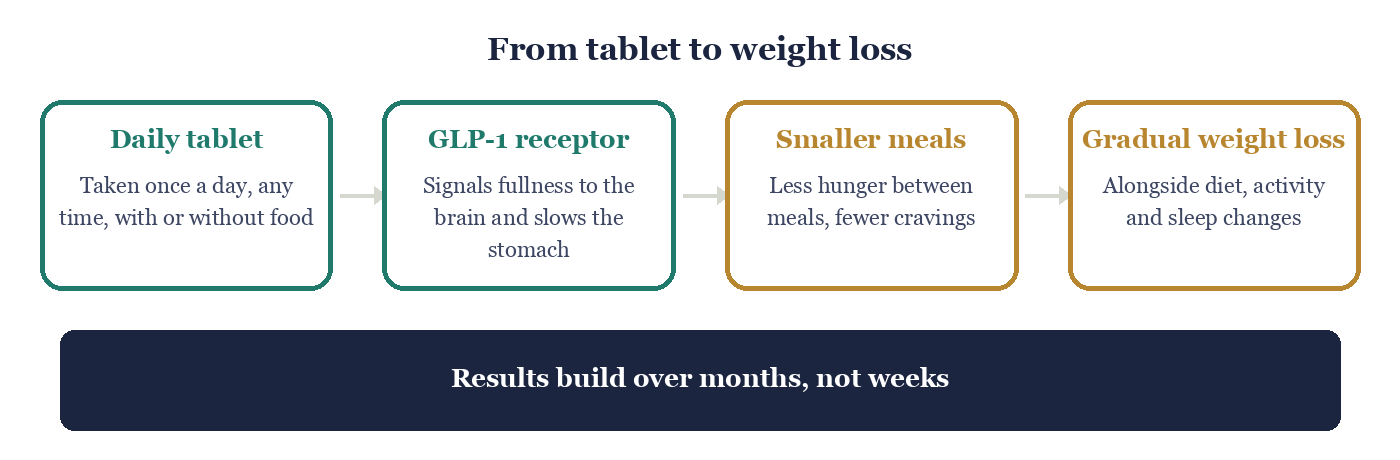
GLP-1 is a hormone the gut releases after you eat. It tells the brain you are full, slows how quickly the stomach empties, and helps the pancreas release insulin when blood sugar rises.
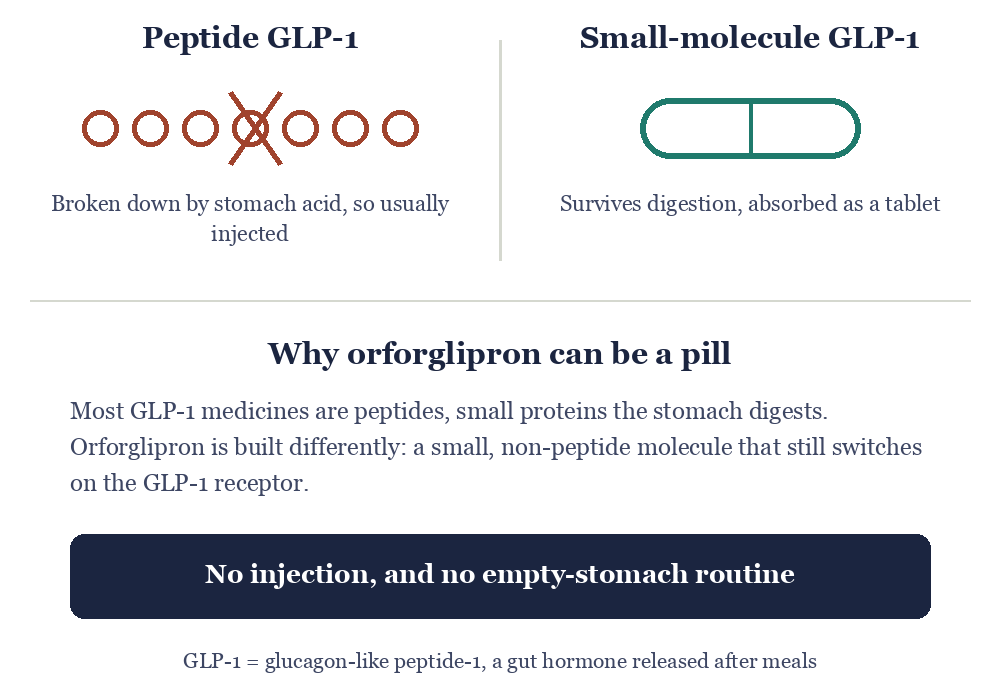
Most GLP-1 medicines are peptides, small proteins that stomach acid breaks down. That is why they are usually injected, and why the one existing GLP-1 tablet needs a strict empty-stomach routine to be absorbed.
Orforglipron is a small, non-peptide molecule that still switches on the GLP-1 receptor. It survives digestion, so it can be swallowed as an ordinary tablet once a day, at any time, with or without food. (3) (4)
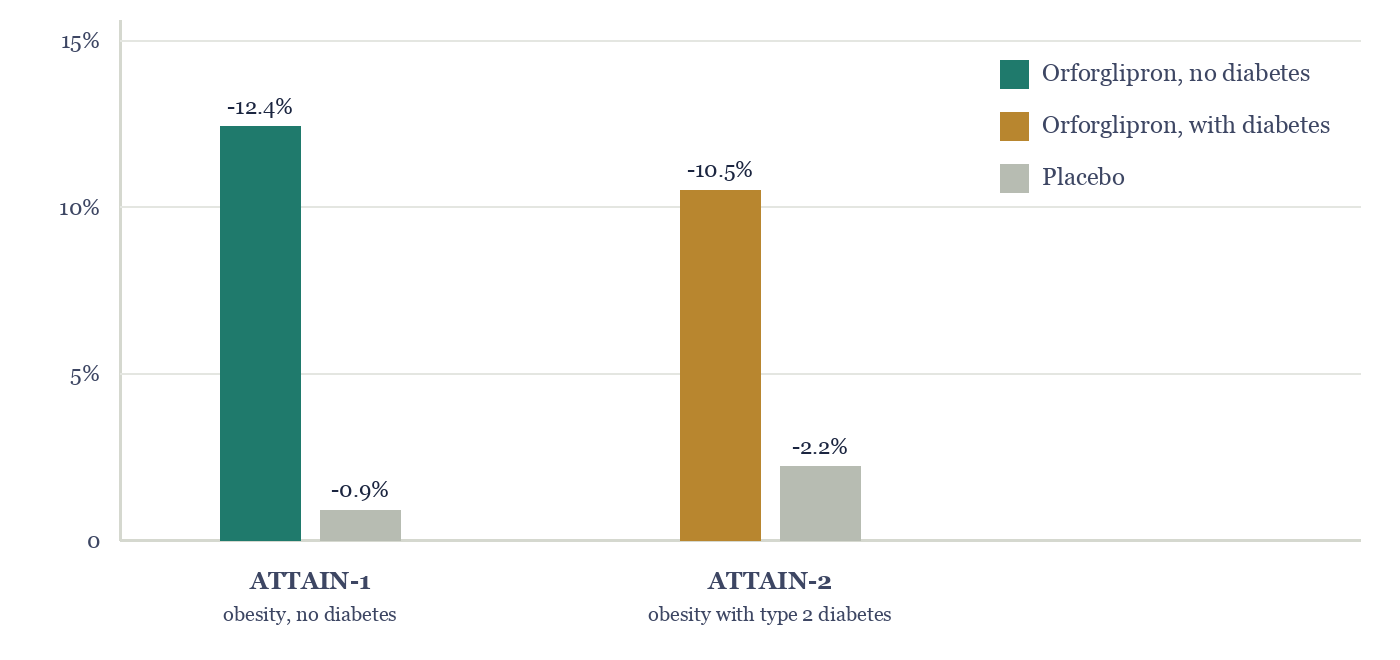
ATTAIN-1 and ATTAIN-2 were phase 3, randomised, double-blind, placebo-controlled trials run over 72 weeks. Everyone taking part also received advice on diet and physical activity. (1) (2)
Trial
Population (n)
Weight change, top dose
Weight change, placebo
Type 2 diabetes
ATTAIN-1
3,127 · obesity or overweight
-12.4%
-0.9%
No
ATTAIN-2
1,613 · obesity or overweight
-10.5%
-2.2%
Yes
At 72 weeks, people on the highest dose (36 mg) lost an average of 12.4% of their body weight, compared with 0.9% on placebo. Weight came off gradually and was still falling slowly towards the end of the trial. (1)
People with type 2 diabetes usually lose less weight on GLP-1 medicines than people without it. On the highest dose, average weight loss was 10.5% versus 2.2% on placebo, alongside lower blood sugar (HbA1c). (2)
Besides body weight, the ATTAIN trials tracked several heart and metabolic markers. Orforglipron was associated with improvements in:
These were secondary measures. The trials were not designed to show whether orforglipron prevents heart attacks or strokes; longer studies looking at those outcomes are still running. (1) (2)
Because orforglipron has no fasting window, it can be taken alongside other morning medicines. A simpler routine can make it easier to stay on treatment, which matters, because weight loss medicines only work for as long as they are taken.
When GLP-1 treatment stops, appetite usually returns and weight tends to come back. Researchers are now studying whether a daily tablet like orforglipron could help people hold on to their weight loss after a course of weekly injections. (7)
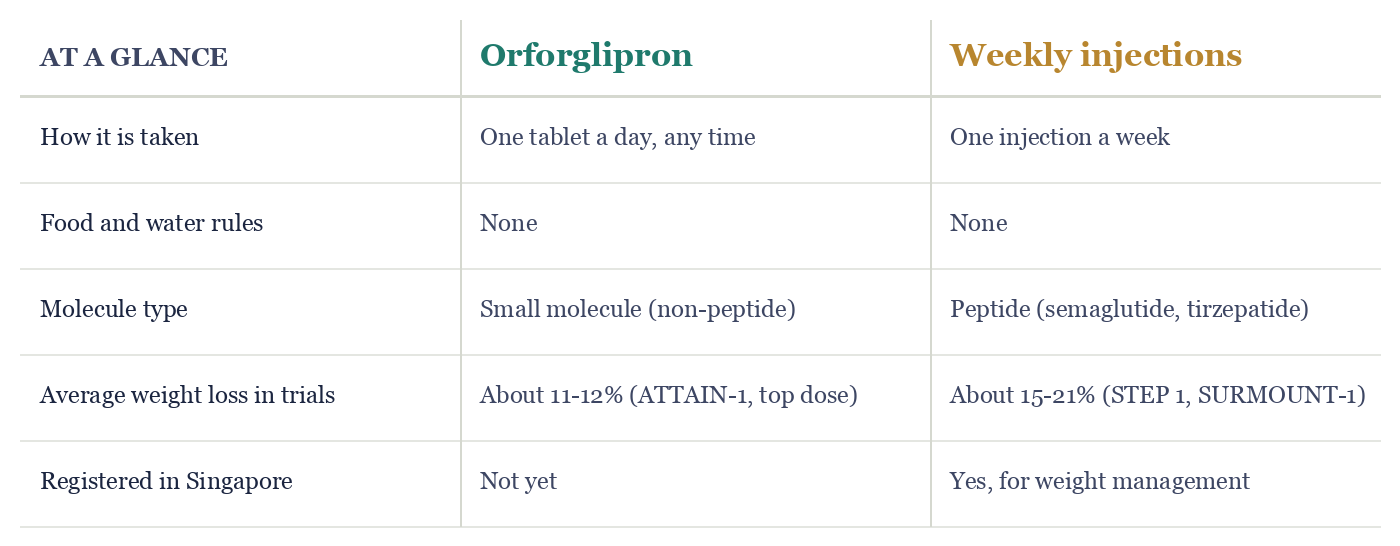
Orforglipron joins a group of GLP-1 medicines that already includes weekly semaglutide and tirzepatide injections. Here is how they compare on the evidence so far.
In their own phase 3 trials, weekly semaglutide 2.4 mg produced average weight loss of about 15% over 68 weeks, and weekly tirzepatide about 21% at its highest dose over 72 weeks. (8) (9)
Orforglipron's average result, about 11 to 12%, is lower. The trials enrolled different people and were not run head to head, though, so the numbers can't be compared directly.
The trade-off is convenience: one tablet a day, no needles and no timing rules. For some people, that makes long-term treatment easier to keep up. A doctor can help you weigh these factors against your health goals.
在整个治疗过程中,医疗监督是必要的,以确保患者的安全和治疗的有效性。
Commonly reported effects

Studies and sources cited in this document


