


菜单



立即预约

英 / 中


远程问诊

立即咨询



A note on terminology
This page uses semaglutide, the generic name, for both the daily tablet and the weekly injection, in line with Singapore's medical advertising guidelines, which restrict reference to registered trade names.
The tablet and the injection share an active ingredient but not a registered use. It is worth being clear on the difference before you see a doctor.
✓ 2019 — First GLP-1 tablet approved. US regulators approved oral semaglutide for adults with type 2 diabetes, the first GLP-1 medicine available as a tablet. (1)
✓ Singapore — Registered for type 2 diabetes. Here, the tablet is registered to improve blood sugar control in adults with type 2 diabetes, alongside diet and exercise. (5)
✓ Late 2025 — Higher-strength tablet approved overseas for weight. US regulators approved a 25 mg daily semaglutide tablet for chronic weight management, based on the OASIS trials. It is a different product from the diabetes tablet. (4)
▸ Weight management — Not registered in Singapore. The diabetes tablet is not registered here for weight loss. Using it for weight alone would be off-label, and is a decision for a doctor after a full assessment. (5)
Semaglutide is a peptide, a small protein that stomach acid normally breaks down. Swallowed on its own, almost none of it would reach the bloodstream.
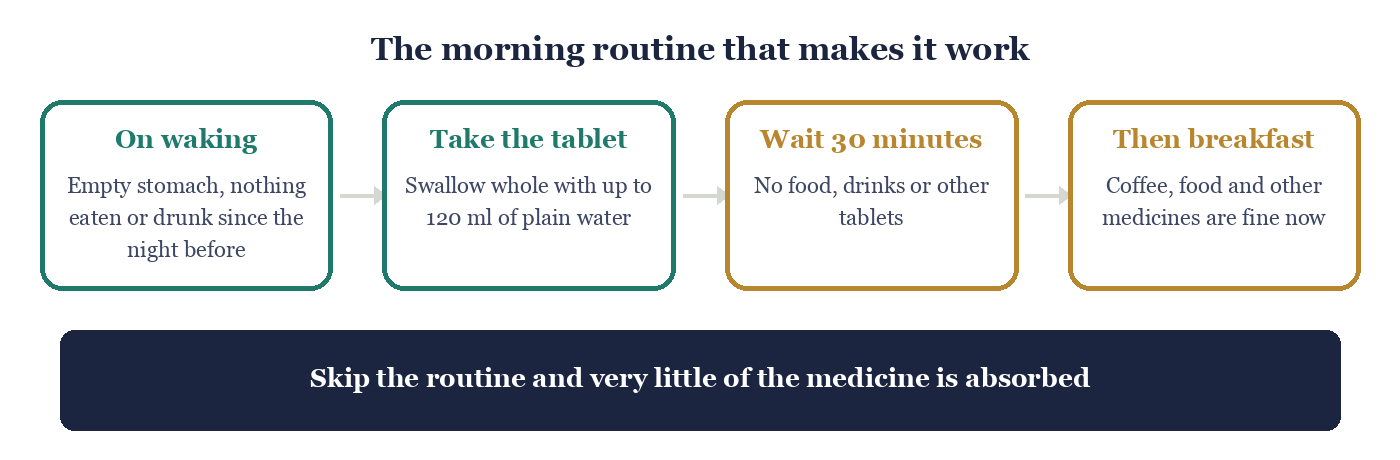
The tablet contains an absorption enhancer called SNAC, which briefly protects semaglutide and helps it cross the stomach lining. That protection only lasts a short time, and food, drinks or other tablets easily disrupt it. (2)
That is why the timing rules matter. Even when they are followed, only a small fraction of each tablet is absorbed, so tablet doses are measured in milligrams per day rather than fractions of a milligram per week.
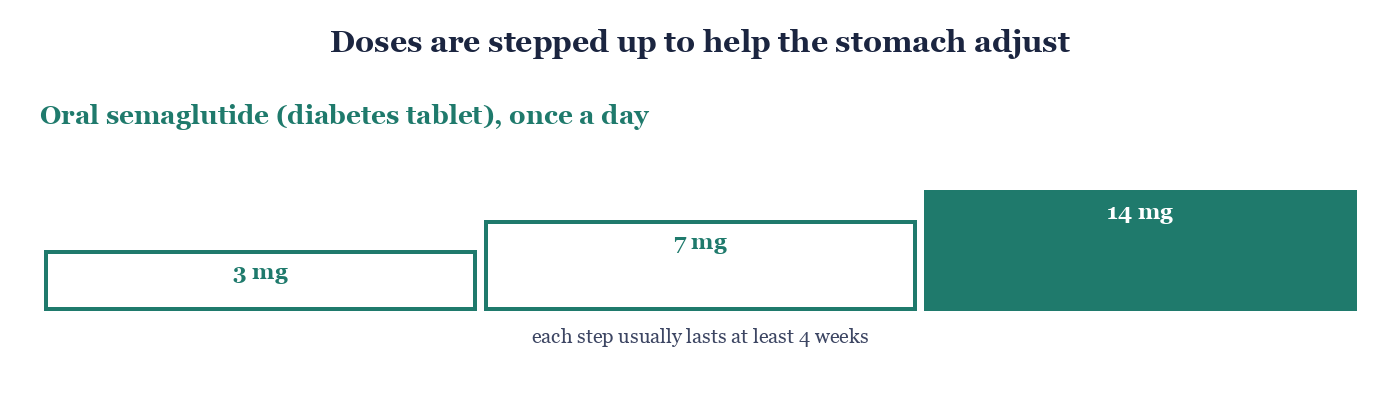
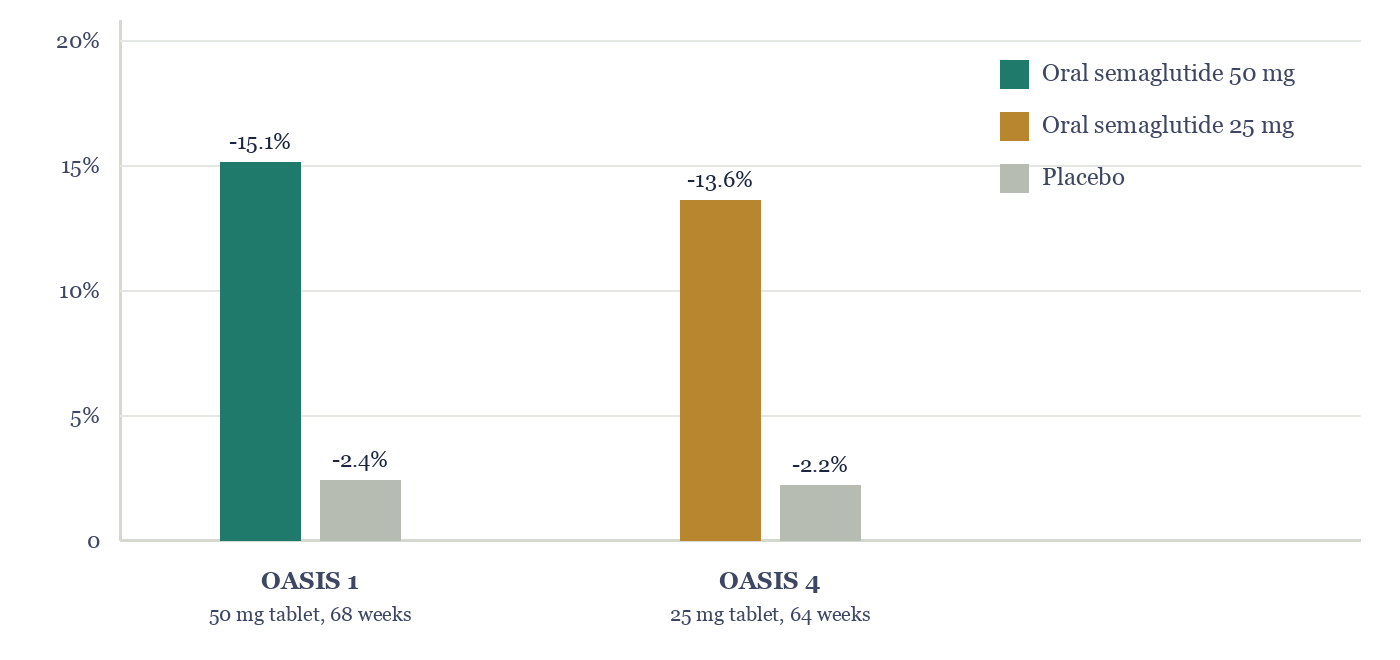
Oral semaglutide has been studied at two very different strengths: the diabetes doses (up to 14 mg a day) in the PIONEER trials, and much higher doses made for weight management in the OASIS trials. (3) (4)
Trial
Population (n)
Dose and duration
Weight change
Placebo
PIONEER 1
703 · type 2 diabetes
14 mg a day, 26 weeks
-3.7 kg
-1.4 kg
OASIS 4
307 · obesity or overweight
25 mg a day, 64 weeks
-13.6%
-2.2%
In people with type 2 diabetes, the 14 mg tablet lowered HbA1c and led to modest weight loss, about 3 to 4 kg on average over six months. That is useful, but much less than with medicines designed for weight management. (3)
When much higher daily doses were tested in people with obesity, weight loss was far larger: 13.6% with 25 mg over 64 weeks in OASIS 4, and 15.1% with 50 mg over 68 weeks in OASIS 1, compared with about 2% on placebo. (4) (6)
Alongside weight, oral semaglutide was associated with improvements in:
In people with type 2 diabetes and heart or kidney disease, a large outcome trial (SOUL) found that oral semaglutide reduced major cardiovascular events compared with placebo. (7)
Results depend heavily on taking the tablet correctly every morning. Missed or mistimed doses are one of the most common reasons the tablet seems not to work.
Your doctor will look at your diagnosis, your BMI using Asian cut-offs, blood sugar, kidney function, other medicines, and whether a daily morning routine is realistic for you. People with a personal or family history of medullary thyroid cancer or MEN2 should not take semaglutide. (5) (8)
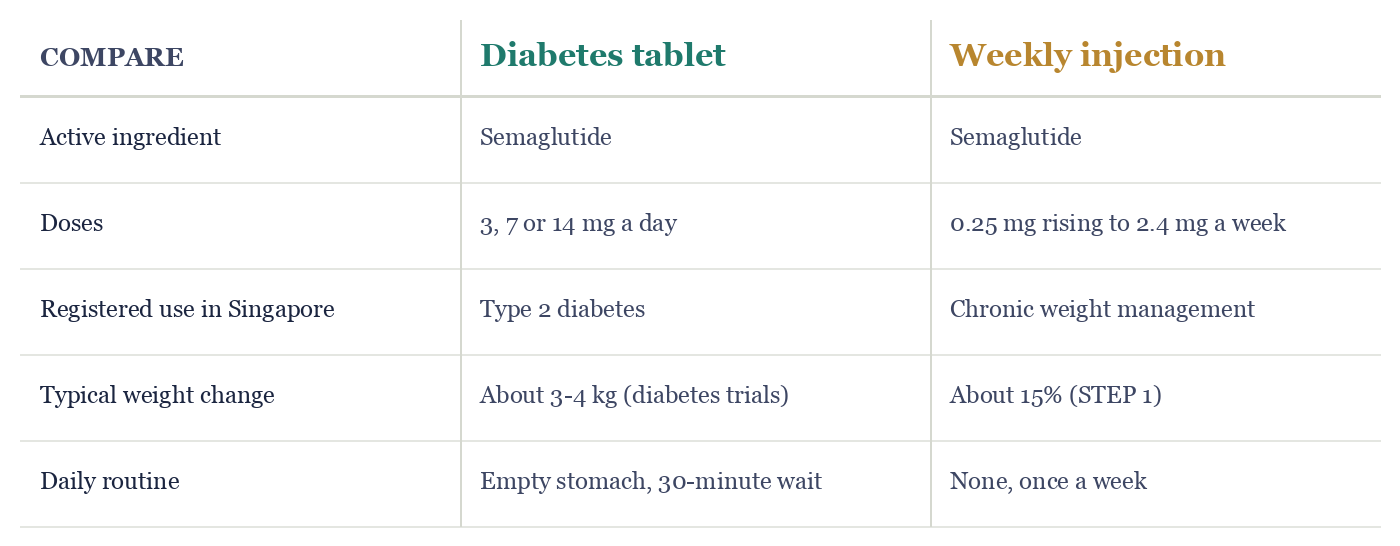
Both contain semaglutide, but they are different products with different registered uses in Singapore.
The weekly injection, up to 2.4 mg, is registered for chronic weight management. In the STEP 1 trial it produced average weight loss of about 15% over 68 weeks. (9)
The daily diabetes tablet, up to 14 mg, is registered for type 2 diabetes. Its effect on weight is smaller, and it needs the empty-stomach routine every morning.
Some people prefer a tablet to an injection; others prefer one dose a week with no daily rules. A doctor can help you decide which fits your health and your routine.
在整个治疗过程中,医疗监督是必要的,以确保患者的安全和治疗的有效性。
Commonly reported effects

Studies and sources cited in this document


